





Your Cart Is Empty!

Muscle Loss After 40: Why It Happens and How to Prevent It
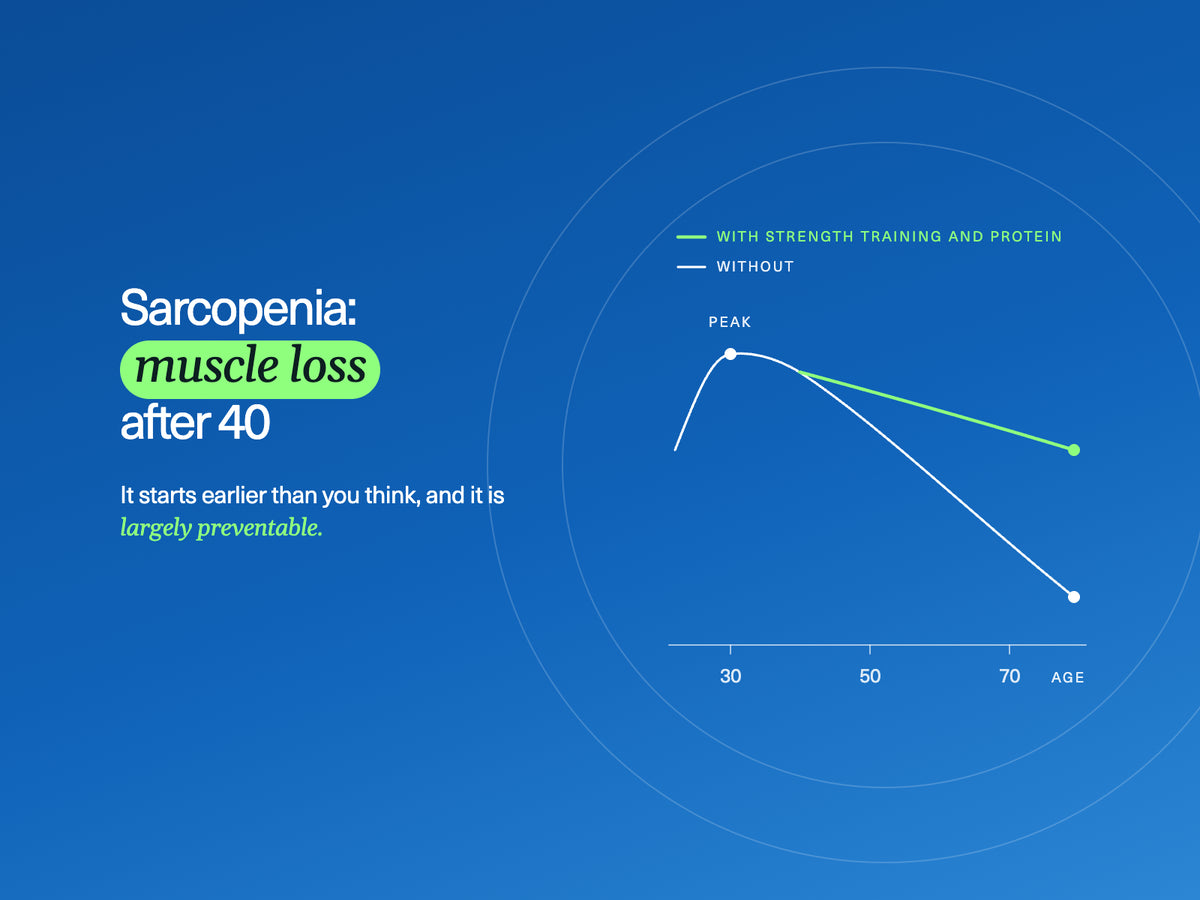
From your 30s, you lose muscle and strength as you age, at about 3–8% of muscle mass a decade, and the loss speeds up after 60. In a national study of 26,780 Indians aged 60 and over, almost half had significant muscle loss. It is what turns into weakness, falls and frailty later in life, and doctors call it sarcopenia. It is largely preventable with two things: strength training, and enough protein with enough leucine at every meal.
Perhaps you have noticed it yourself. Jars are harder to open. You push on your knees to get out of a low chair. Or you have watched it happen to a parent: slower on the stairs, a little unsteady, a fall that came out of nowhere. Most people put this down to "just getting older". It has a name, it has a cause, and you can do something about it, starting now.
Key facts
- Sarcopenia is a progressive loss of muscle mass and strength. Doctors now treat it as a muscle disorder in its own right, linked to falls, fractures, disability and earlier death.
- Muscle mass falls by about 3–8% a decade after age 30, and faster after 60.
- After 50, leg muscle falls by 1–2% a year and strength by 1.5–5% a year. Strength goes faster than size.
- In the Longitudinal Ageing Study in India, 43.6% of 26,780 adults aged 60 and over had sarcopenia, and 19.4% had the severe form.
- Adding protein to strength training builds more muscle and leg strength in older adults than training alone.
- Adults over 50 need about 3.5g of leucine in a meal to fully switch on muscle building. One VaraPace shot provides 3.89g.
What age-related muscle loss is, and why it happens
The medical word, sarcopenia, comes from Greek: sarx, flesh, and penia, loss. In 2019 the European expert group defined it as a progressive and generalised muscle disorder, with low muscle strength as its main sign. Muscle reaches its peak in young adulthood. After that, if nothing changes, it slowly declines.
Three things drive it:
- Less use. Muscle you do not challenge, you lose. Desk jobs, cars and lifts mean most adults rarely lift anything heavy.
- A weaker response to protein. With age, a meal needs more protein, and more leucine, to switch on muscle building than it did at 25. A breakfast of tea and toast falls well short.
- Too little protein overall. A typical Indian day's food provides about 40–45g of protein, below what an adult over 40 needs.
The loss is slow, which is why it goes unnoticed. A few percent a decade does not show in the mirror. But it compounds. By 70, someone who did nothing about it has lost a large share of the muscle they had at 30, and an even larger share of their strength.
Why it matters
Muscle is what gets you out of a chair, up the stairs and back on your feet when you trip. When it falls below a certain level, everyday life gets harder and falls become more likely. Losing muscle with age is linked to falls, fractures, loss of independence and earlier death.
It is also common. Worldwide, 10–27% of people over 60 have significant age-related muscle loss, depending on how it is measured. In India, a national study using the Asian criteria found it in 43.6% of adults aged 60 and over. That is almost one in two.
How to tell if you are losing muscle
The early signs are easy to miss:
- Opening jars or carrying shopping feels harder than it used to.
- You use your hands to push up from a chair or the floor.
- You walk more slowly, or friends keep getting ahead of you.
- You lose weight without trying, or your arms and legs look thinner.
- You feel less steady on stairs or uneven ground.
A one-minute test you can do at home
Doctors in Asia use a simple test called the five-times chair stand.
- Sit on a firm, straight-backed chair, about knee height, with your feet flat on the floor.
- Cross your arms over your chest.
- Stand up fully and sit back down five times, as fast as you safely can, without using your hands.
- Have someone time you from "go" to the moment you sit down the fifth time.
If it takes 12 seconds or longer, that is the cut-off Asian muscle-health experts use for low physical performance. It is a signal to act, and worth mentioning to your doctor. Do this test with someone nearby if you are unsteady.

A doctor can add a grip-strength test with a hand gauge and, if needed, a body scan to measure muscle directly.
How to prevent it
Losing muscle with age is not inevitable. Two habits protect your muscle, and they work best together.
1. Strength training
Muscle responds to being used, at any age. Lifting weights, resistance bands, squats from a chair, climbing stairs: anything that makes your muscles work against resistance tells your body to keep them. Twice a week is enough to start.
2. Enough protein, at every meal
Training sends the signal. Protein supplies the building material. In an analysis of 17 trials in older adults with an average age of 73, those who added protein to their strength training gained more lean muscle and more leg strength than those who trained alone. A larger analysis of 49 trials with 1,863 people found the same: protein during strength training added both muscle and strength.
How much you need rises with age:
| Age | Daily protein per kg | For a 65kg adult |
|---|---|---|
| 40s | 1.0–1.2g | 65–78g |
| 50s | 1.0–1.3g | 65–85g |
| 60s and over | 1.2–1.5g | 78–98g |
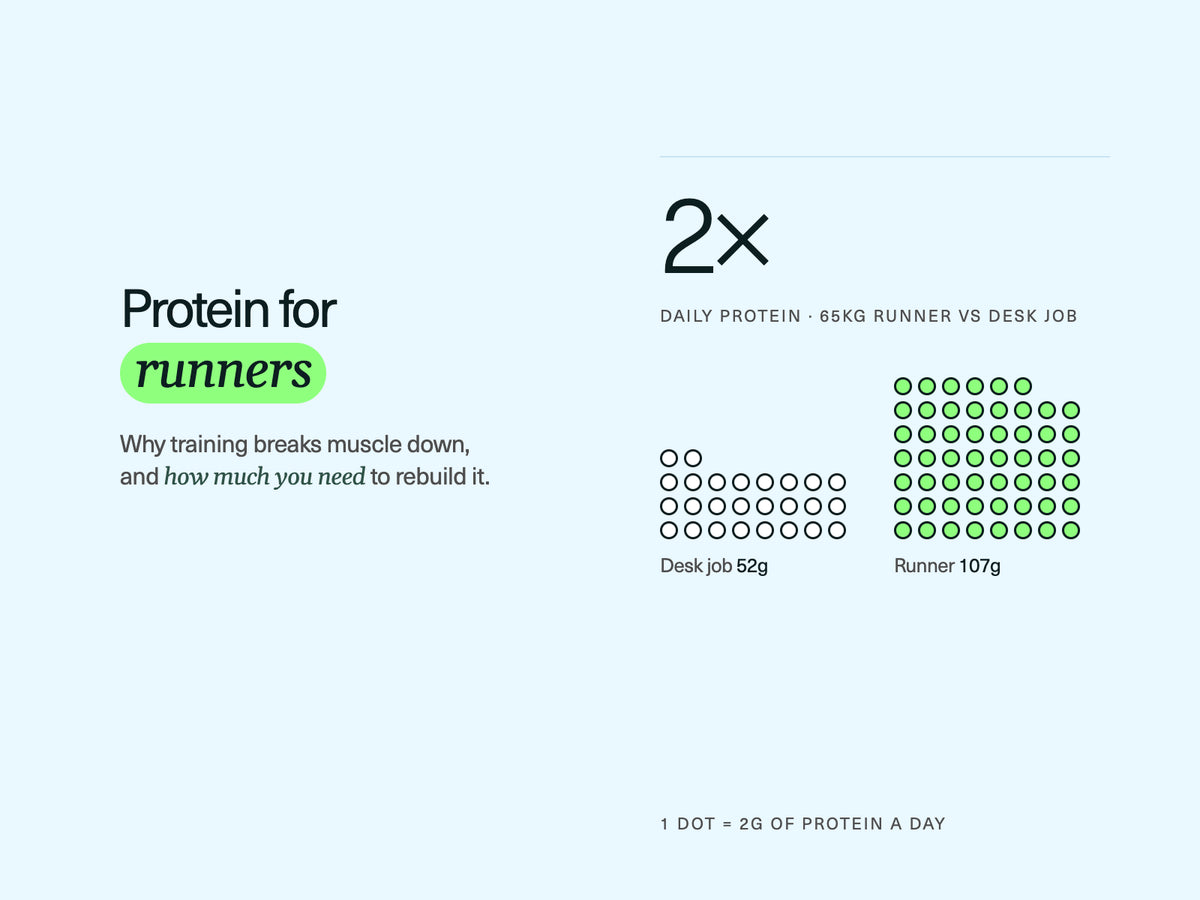
A typical Indian day provides about 40–45g. That leaves most adults over 40 short by 20–50g, every day, for years. More in How Much Protein Do You Need After 40?
3. Enough leucine in each meal
Leucine is the amino acid that switches muscle building on. Adults over 50 need about 3.5g of it in a meal to get the full effect. Most Indian meals, built around rice, roti and dal, do not reach it. This is why the amount of protein in each meal matters, not just the daily total. More in Leucine: The Amino Acid That Decides Whether Your Protein Works.
Why VaraPace makes the protein part easy
Strength training takes effort. Getting enough protein should not. VaraPace is built to close the gap in one step.
- 24g of protein in 110ml. A few sips, not a heavy shake.
- 3.89g of leucine, above the 3.5g an adult over 50 needs to fully switch on muscle building.
- Pure BLG (beta-lactoglobulin), the most leucine-rich protein in whey.
- 98 calories, with zero sugar, fat, carbs or lactose. No bloating.
- 1g of OptiMSM® for joints.
- Nothing to mix, no fridge until opened. Keep a few in your bag or send a box to your parents.
- Vegetarian, made from milk.
VaraPace is rated 4.96 out of 5 by 96 verified buyers.
“Excellent product, ordered for my parents and they really enjoyed it”
Jigyasu W., verified buyer
“The varapace protien i am using is so effective that I play club level picleball and have become quiet competitive ,thanks varapace”
Surendar C., verified buyer
Is it worth the price?
VaraPace costs ₹333 a shot in a pack of 24, or ₹366 in a pack of 6. For that you get a full, leucine-rich serving of protein in 110ml that you will actually take every day, which is what protects muscle over years. The full numbers are in Is VaraPace Worth the Price?
A simple plan
- Do the chair-stand test today. Write down your time and repeat it every three months.
- Strength train twice a week. Chair squats, wall push-ups, resistance bands or weights. Start easy and build up.
- One VaraPace shot a day, at the meal where you get the least protein. For most people that is breakfast.
- A real protein source at lunch and dinner: paneer, curd, eggs, dal with sprouts, chicken or fish.
- Buying for a parent? Start them on one shot a day, and see Protein for Parents Over 60.
Women: muscle loss speeds up in the 40s and 50s. See Protein for Women Over 40.
Try the VaraPace Assorted Pack
Taking it every day? Subscribe and save up to a further 10%.
When to see a doctor
See a doctor if you or a parent has:
- Weakness that has no clear cause, or that is getting worse.
- A fall, or more than one near-fall.
- Weight loss without trying.
- Difficulty getting up from a chair without using the hands.
A doctor can check grip strength, walking speed and muscle mass, and rule out other causes. If you are under a doctor's care for your kidneys, follow their protein advice. For everyone else, more protein is safe: see Does Protein Harm Your Kidneys?
Frequently asked questions
What is age-related muscle loss in simple words?
It is the loss of muscle and strength that comes with age. Doctors call it sarcopenia. Left alone, it leads to weakness, falls and loss of independence.
At what age does muscle loss start?
From your 30s. Muscle mass falls by about 3–8% a decade after 30, and faster after 60.
Can muscle loss after 40 be reversed?
Muscle responds to strength training and protein at any age. Older adults in clinical trials who combined the two gained lean muscle and leg strength.
How much protein do I need to prevent muscle loss?
About 1.0–1.2g per kg of body weight a day in your 40s, rising to 1.2–1.5g per kg from your 60s. Spread it across meals, with about 3.5g of leucine in each.
Is walking enough to keep my muscle?
Walking is good for your heart, but it does not challenge your muscles enough on its own. Add strength training twice a week.
Is protein safe for my elderly parents?
Yes. Older adults need more protein, not less. If a parent is under a doctor's care for their kidneys, follow that doctor's advice on how much.
References
- Cruz-Jentoft AJ, et al. Sarcopenia: revised European consensus on definition and diagnosis. Age Ageing. 2019;48(1):16–31. Full text
- Chen LK, et al. Asian Working Group for Sarcopenia: 2019 consensus update on sarcopenia diagnosis and treatment. J Am Med Dir Assoc. 2020;21(3):300–307. PubMed
- Volpi E, Nazemi R, Fujita S. Muscle tissue changes with aging. Curr Opin Clin Nutr Metab Care. 2004;7(4):405–410. Full text
- Prevalence and determinants of sarcopenia among older adults in India: insights from the Longitudinal Aging Study in India. J Am Geriatr Soc. 2025;73(5):1429–1440. PubMed
- Petermann-Rocha F, et al. Global prevalence of sarcopenia and severe sarcopenia: a systematic review and meta-analysis. J Cachexia Sarcopenia Muscle. 2022;13(1):86–99. Full text
- Liao CD, et al. Effects of protein supplementation combined with resistance exercise on body composition and physical function in older adults: a systematic review and meta-analysis. Am J Clin Nutr. 2017;106(4):1078–1091. PubMed
- Morton RW, et al. A systematic review, meta-analysis and meta-regression of the effect of protein supplementation on resistance training-induced gains in muscle mass and strength in healthy adults. Br J Sports Med. 2018;52(6):376–384. Full text
- Moore DR, et al. Protein ingestion to stimulate myofibrillar protein synthesis requires greater relative protein intakes in healthy older versus younger men. J Gerontol A. 2015;70(1):57–62. PubMed
This article is for general information and is not medical advice. Speak to your doctor before changing your diet if you are under medical care.