






Your Cart Is Empty!

Why Sleep Gets Worse After 40, and What Helps
From midlife, sleep changes in three measurable ways: deep sleep declines, you wake more often during the night, and total sleep time shortens. A meta-analysis of 65 studies found all three across adulthood. For women, perimenopause adds to it. The change is normal, but poor sleep is not something you have to accept: in a trial of adults aged 35–55, magnesium L-threonate improved deep sleep, REM sleep and next-day alertness within three weeks.
You go to bed tired and lie awake. Or you fall asleep and are up at 3am with your mind already at work. You get your hours and still wake unrefreshed. If this started somewhere around 40, there are reasons for it, and there is something you can do.
Key facts
- A meta-analysis of 65 studies found that total sleep time, and the share of the night spent in deep sleep, both decline with age, while time awake after falling asleep increases.
- Total sleep time falls until about 60 and then levels off.
- Sleep problems are reported by 39–47% of women in perimenopause and 35–60% after menopause.
- In a 2024 placebo-controlled trial of adults aged 35–55 with sleep problems, 1g of magnesium L-threonate a day improved sleep quality and next-day alertness in 21 days.
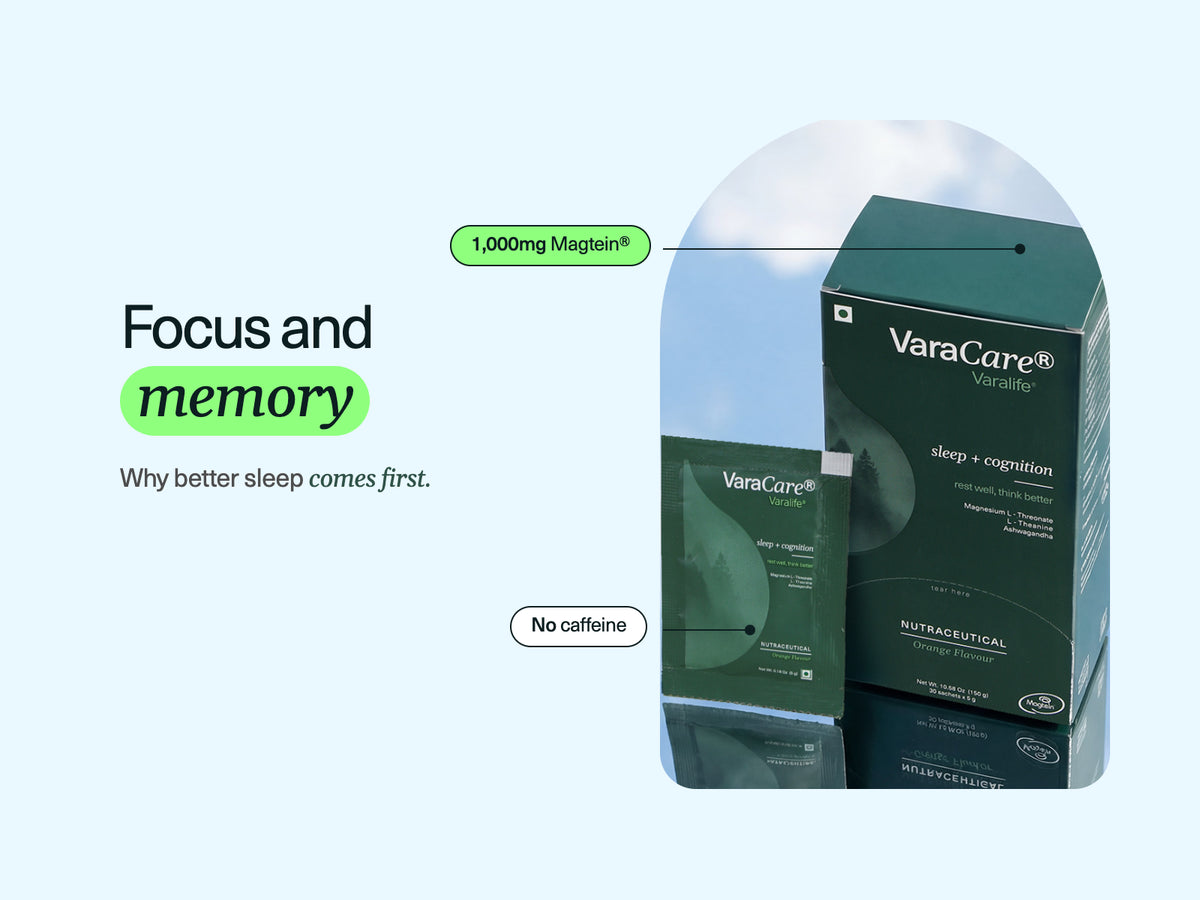
- One VaraCare sachet contains that same 1g, with no melatonin.
What actually changes
Deep sleep shrinks. Deep, slow-wave sleep is the most physically restoring stage. Its share of the night falls steadily through adulthood. This is why seven hours at 45 can feel like less than seven hours at 25.
You wake more. Time spent awake during the night rises with age. Sleep becomes lighter and easier to break: a noise, a full bladder, a passing thought.
Total sleep shortens. The night itself gets shorter until around 60.
Hormones shift. For women, the years around menopause bring hot flushes and night sweats, which affect most women in the transition and are a leading cause of broken sleep.
Life is heavier. Midlife tends to stack work pressure, children, ageing parents and money worries. A body that used to sleep through stress stops doing so.

What helps
- Keep one wake-up time, including weekends. It is the strongest signal your body clock has.
- Get daylight in the morning and dim the lights at night.
- No caffeine after lunch, and go easy on alcohol.
- Do some strength or aerobic exercise most days, not late in the evening.
- Give your mind an off-ramp. A fixed wind-down hour without work or news.
- Add the right support.
Why people over 40 turn to VaraCare
Habits fix timing. They do not fix what changed with age: a mind that stays switched on, and sleep that is too light to restore you. That is what VaraCare was built for.
- 1,000mg of Magtein® magnesium L-threonate. The amount used in the 2024 sleep trial, whose participants were aged 35–55 and had better deep and REM sleep and better alertness the next day.
- 2,000mg of glycine to help you fall asleep faster and wake clearer.
- 500mg of ashwagandha, shown in pooled trials to improve sleep.
- L-theanine, L-tryptophan and chamomile to settle the mind.
- No melatonin and no sedative.
- One sachet in water, an hour before bed, which becomes a wind-down ritual in itself.
VaraCare is rated 4.6 out of 5 by verified buyers.
“Good it has increased my energy levels, focus, deeper sleep.”
Praveen K., verified buyer
“Excellent results worth the price.”
Dinesh S., verified buyer
Is it worth it?
Consider what poor sleep is already costing you: the slow mornings, the short temper, the afternoon you cannot concentrate, the workout you skip. Against that, one sachet a night with a patented form of magnesium and five supporting ingredients is a small price.
How to try it
- Mix one sachet in water about an hour before bed.
- Take it every night for three weeks, the length of the trial.
- Pair it with a fixed wake-up time, so the two work together.
More on the ingredients: Magnesium L-Threonate vs Glycinate vs Citrate and Sleep Supplements Without Melatonin.
When to see a doctor
See a doctor if you snore loudly or gasp in your sleep, have had insomnia for more than a few weeks, or have hot flushes or night sweats that wake you regularly. Do not use VaraCare if you are pregnant or breastfeeding, or under 18. If you have a thyroid or autoimmune condition, or take antidepressants, sleep medicines, hormone therapy, thyroid or blood-pressure medication, speak to your doctor first.
Frequently asked questions
Is it normal to sleep worse after 40?
Yes. Deep sleep and total sleep time decline with age and night-time waking increases. It is common, and it can be improved.
Why do I wake up at 3am?
Sleep is lighter in the second half of the night and becomes lighter still with age, so stress, alcohol, a warm room or a full bladder wake you more easily.
Does menopause affect sleep?
Yes. Sleep problems are reported by 39–47% of women in perimenopause and 35–60% after menopause, often linked to hot flushes and night sweats.
Can magnesium help sleep after 40?
Yes. In a placebo-controlled trial of adults aged 35–55 with sleep problems, 1g of magnesium L-threonate a day improved sleep quality and daytime alertness in 21 days.
How much sleep do I need at 45?
Most adults do best with seven hours or more. Quality matters as much as length, which is why deep sleep is worth protecting.
References
- Ohayon MM, et al. Meta-analysis of quantitative sleep parameters from childhood to old age in healthy individuals. Sleep. 2004;27(7):1255–73. PubMed
- Review of sleep in midlife women and the menopausal transition. Full text
- Hausenblas HA, et al. Randomised, placebo-controlled trial of magnesium L-threonate for sleep in adults with self-reported sleep problems. Sleep Med X. 2024;8:100121. PubMed
- Cheah KL, et al. Effect of Ashwagandha (Withania somnifera) extract on sleep: a systematic review and meta-analysis. PLoS One. 2021. PubMed
This article is for general information and is not medical advice. VaraCare is a food supplement and is not intended to diagnose, treat, cure or prevent any disease.